County Programs Hazardous Waste
The Community Hazardous Waste Collection Center (Center), located on Mesa Road on the campus of the University of California at Santa Barbara, will be closed on July 3rd and 4th in observance of the Independence Day holiday. It will be open on July 5th, however, from 11:00 a.m. to 3:00 p.m. for acceptance of hazardous waste from households. The Center will resume normal operating hours on July 10th by accepting hazardous waste from businesses between 9:00 a.m. and 3:00 p.m., subject to applicable fees and by appointment only. To schedule an appointment, please call (805) 882-3602. Normal operating hours for the Center will also be in effect on July 11th and 12th for accepting hazardous waste from households from 9:00 a.m. to 3:00 p.m. and from 11:00 a.m. to 3:00 p.m., respectively. If you have any questions, please call (805) 882-3602.
What are Household Hazardous Wastes? Household Hazardous Wastes ( HHWs ) are materials commonly used in and around residential households that contain toxic substances. These include household cleaning products (drain cleaners, oven cleaners, floor and furniture polish); painting products (paints, stains, finishing products and thinners); automotive products (motor oil, old gasoline, anti-freeze, car batteries, transmission, brake and steering fluids, solvents); garden products (fertilizers, pesticides, herbicides); hobby supplies (solvents, photochemicals); and pool supplies (Chlorine).
Explosives, biohazardous and radioactive materials are not considered HHW and are not accepted at HHW collection facilities and events.
In an effort to reduce the amount of HHW requiring treatment and disposal, consider alternatives, only buy what you need, and make an effort to use all that you buy. All of these products should be properly stored in dry, cool, well ventilated areas, out of reach of children.
Why is it important to keep Household Hazardous Wastes out of landfills? Although new landfills have liners and leachate collection systems, it is illegal for area landfills to accept HHW. It is vitally important to keep HHWs out of landfills, where they may affect water quality and impact area resources. Water infiltrating buried waste can collect a variety of harmful substances that may be present, and carry them into ground and surface water supplies as landfill leachate.
What are some adverse effects that can result from the improper handling or disposal of HHW?
- Children can be seriously harmed by eating, drinking, touching, or breathing toxic household chemcials - Refuse handlers and disposal site personnel can be injured by discarded HHW (e.g. exploding aerosol cans, chemicals coming in contact with their faces or hands, or poisonous fumes caused by mixed chemicals); - Fire fighters can be injured by hazardous household chemicals when responding to a fire; - Groundwater used for drinking or irrigation can be contaminated when HHW products are poured and then seep into the ground; - Bacteria needed to break down sewer and septic tank wastes can be destroyed by untreated HHW.
Transporting and Labeling Hazardous Waste
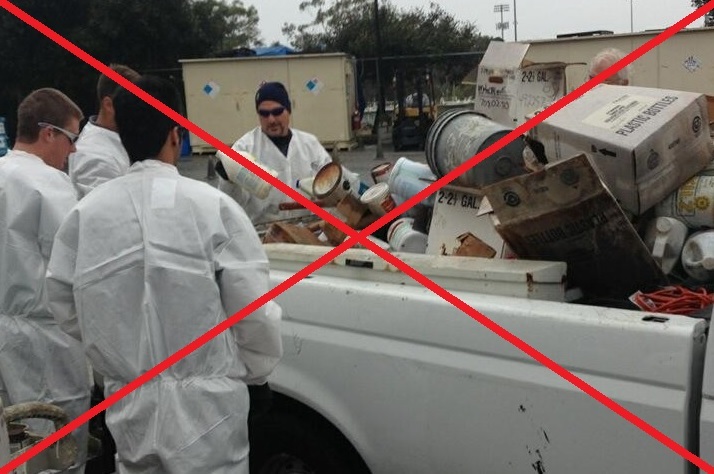
Caution should be taken when transporting hazardous waste. If possible, use the original product container or label the container if the contents are different from the label on the container. Cover all containers with a secure fitting lid and pack containers upright in a leak-proof box. You may be asked to provide a detailed inventory, if you have complex chemicals or laboratory waste.
State and federal hazardous waste laws limit the use of hazardous waste collection facilities to households and businesses that qualify as a Conditionally Exempt Small Quantity Generator (CESQG). To qualify as a CESQG, a generator must not produce more than 100 kilograms (27 gallons or 220 pounds) of hazardous waste per month, including a maximum of 1 kilogram (1 quart or 2.2 pounds) of acutely hazardous waste. Businesses that generate more than this amount are required to use a licensed hazardous waste hauler to manifest and transport their waste.
Households may not transport more than 15 gallons (in maximum 5-gallon containers) or 125 pounds (dry weight) of HHW to a HHW collection facility at one time. Individuals who generate more than this amount are required to make multiple visits. Please contact the facility directly for more information.
Pharmaceutical Waste
The proper disposal of pharmaceutical waste, including expired or unwanted prescription and over-the-counter medications, has been a growing challenge nationwide. Traditionally, consumers have thrown unwanted medicines or pharmaceutical waste into their trash containers, have poured them down their sinks, or have flushed them down their toilets. While the latter two options can especially prevent the accidental or purposeful ingestion of inappropriate drugs or dangerously high doses of drugs by those for whom the medication was not intended, particularly children, they should no longer be chosen as disposal options. Pharmaceutical waste disposed of through these options can establish a long-term harmful presence in the environment from its excreted residues or byproducts that sometimes cannot be removed by sewage treatment or water treatment processes. These residues pose unknown risks to people, animals, and the environment, especially our waterways. Human exposure to such residues can occur by contact, by ingestion of water, or by ingesting food crops grown on land treated with sludge or irrigated with wastewater.
The best option for households to dispose of their pharmaceuticals is to take them to a local hazardous waste collection facility that will accept them. If this option is not available, then the expired or unwanted pharmaceuticals should be thrown into the trash using the following guidelines:
place old medications in a container with a tight fitting lid;
if possible, render the medications undesirable and/or unusable by crushing them (if solid) and mixing with small amounts of water, salt, or other substance that would increase the difficulty of consumption;
as an extra precaution for privacy purposes, remove any personal information from the label (e.g. name, address, and telephone number) by scratching out the information or using a permanent marker to cover the information;
securely tape the container (e.g. with duct tape) and place it into the trash, preferably on a day of collection so that it is inaccessible to children and pets.
Please note that if the medication is a “controlled substance” (e.g. medications that may be habit forming or have the potential for abuse, such as narcotics or tranquilizers), they should be taken to a local law enforcement office (i.e. a city police department or county sheriff’s department). Controlled substances are regulated by the Federal Drug Enforcement Administration and can only be legally handled by the patient to whom they are prescribed and by law enforcement. Common examples include Codeine, Valium, Ritalin, and anabolic steroids.
Where can I take my Household Hazardous Waste for safe disposal?
In South County:
Community Hazardous Waste Collection Center University of California at Santa Barbara (UCSB) Mesa Road, Building 565 Goleta, CA 93117 (805) 882-3602 The Community Hazardous Waste Collection Center is managed by the County of Santa Barbara's Resource Recovery & Waste Management Division of the Public Works Department and is jointly sponsored by the County of Santa Barbara and the Cities of Goleta and Santa Barbara. To reach the Community Hazardous Waste Collection Center, please follow these directions:
Eligibility
Households may dispose of household hazardous waste (HHW) on Saturdays from 9:00 a.m. to 3:00 p.m. and on Sundays from 11:00 a.m. to 3:00 p.m. The Center is closed when it is raining and on major holidays. Please call (805) 882-3602 in advance on those occasions to determine whether or not the Center will be open.
Businesses in Santa Barbara County that qualify as a Conditionally Exempt Small Quality Generator (CESQG) are eligible to use the Community Hazardous Waste Collection Center on Fridays by appointment. They are required to sign a waiver stating that they are a CESQG. Businesses will be charged a user fee of $23.50 for processing and administration costs, plus a disposal fee based on the types and quantities of waste being disposed. Nonprofit organizations (501 (c)(3)) are eligible for a 25 percent discount, and the user fee is waived.
Lompoc businesses are not eligible, since the City offers a CESQG program. In addition to the $23.50 user fee, businesses located in the Santa Maria/Orcutt area and in the City of Carpinteria will be charged an additional 30 percent to cover overhead costs.
Materials Accepted
The types of HHW described above are accepted, including expired medications. In addition, kitchen grease from households is accepted for recycling. Please ensure that as much of the food residue as possible is removed.
Materials Exchange Program
In an effort to divert waste from regional landfills, the County of Santa Barbara manages a materials exchange program to encourage the reuse of materials that come into the Community Hazardous Waste Collection Center (Center). A materials exchange cart, located at the Center, offers a wide array of usable products. Products such as paints, cleaning supplies, pesticides, and home improvement products are available to members of the local community at no charge. Given the increasing costs of such items when purchased in stores, significant savings may be realized when obtaining these items from the exchange cart, and it is preferable to reuse products rather than recycle them. Perhaps more importantly, by properly reusing these hazardous materials, people can help prevent the pollution of local lands and waterways that result from their improper disposal.
Days and Hours of Operation
Households may dispose of HHW on Saturdays from 9:00 a.m. to 3:00 p.m. and on Sundays from 11:00 a.m. to 3:00 p.m. The Center is closed when it is raining and on major holidays. Please call (805) 882-3602 in advance on those occasions to determine whether or not the Center will be open.
Businesses and all non-households (including churches, schools, agencies, and nonprofit groups) may use the Collection Center on Fridays between 9:00 a.m. and 3:00 p.m., by appointment only. To make an appointment, call the County of Santa Barbara's Resource Recovery & Waste Management Division at (805) 882-3602. Businesses and other non-households may not use the Collection Center on weekend days. The fees listed below pertain to the types of hazardous waste accepted from Conditionally Exempt Small Quantity Generators (CESQG) and are effective from July 1, 2007 through June 30, 2008:
Facility Fee: $23.50
Automotive/Machine Shop
Batteries
Bulked Items (based on net liquid)
Chemicals (based on gross weight)
Miscellaneous
Testing
Asbestos Acceptance Guidelines
Asbestos is a naturally occurring group of mineral fibers that are flexible, fire resistant, and can pose a threat to human health when microscopic fibers become airborne and are inhaled. Asbestos is most commonly found in acoustical spray-on ceiling, pipe insulation, floor tile and mastic, roofing and fireproofing materials, brake and clutch linings, and textured paints. Any of these materials installed prior to 1980 may contain asbestos. Never dust, sweep, or vacuum these items or other products suspected of containing asbestos fibers.
To control harmful emissions of asbestos to the atmosphere, the Santa Barbara County Air Pollution Control District (APCD) enforces Federal laws that control work practices during the demolition and renovation of institutional, commercial, or industrial structures, excluding private residences and apartment buildings having no more than four units. Depending upon the amount and type of asbestos and the type of project, advance notification to the APCD may be required before asbestos is disturbed and/or removed. Please contact the APCD at (805) 961-8800 or visit their website at http://www.sbcapcd.org/biz/asbestos.htm, if you have any questions.
If you are not sure whether a product contains asbestos, you can have a sample tested (see list of testing firms below). You can also contact the manufacturer to inquire about asbestos content or contact the United States Consumer Product Safety Commission (CPSC) at (800) 638-2772.
Once it has been determined that you have an asbestos containing material, please follow these guidelines for disposal of asbestos at the Community Hazardous Waste Collection Center:
The asbestos containing material must be double bagged and sealed (use nine millimeter plastic bags) when it is dropped off at the collection center. If you are abating the asbestos yourself, please call the County of Santa Barbara Public Works Department at (805) 882-3602 to obtain the appropriate bags at no charge. Asbestos delivered in normal trash bags or other types of containers is not acceptable. A labor charge of $60.00 per hour may be imposed if additional handling is required to properly package the asbestos.
If your asbestos has been removed by a certified asbestos abatement company, the bags still need to enter the facility in good condition (rips and tears in the bags are not acceptable, and a $60.00 per hour labor rate may be imposed if additional handling is required).
The weight of each package should be limited to approximately 35 pounds;
Households are limited to bringing a total of 125 pounds of material (approximately four bags) per calendar month for free. If you bring more than that, we can accept the remaining material for $2.20 per pound, or you can bring another 125 pounds for free the next calendar month.
If you have large quantities of non-friable asbestos (i.e. unable to be crumbled by hand pressure) in excess of 125 pounds, please contact the County South Coast Recycling and Transfer Station at (805) 681-4345 to obtain a permit application and further instructions.
Asbestos bags may be obtained for free from the Resource Recovery & Waste Management Division of the Public Works Department, located at 130 East Victoria Street, Suite 100, in Santa Barbara.
Asbestos Testing Services
Channel Coast Corporation 525 East Micheltorena, Suite 101 Santa Barbara, CA 93101 (805) 966-1480 (Call for instructions and bring in a sample to be tested.)
Independent Building Inspections 3009 De La Vina Santa Barbara, CA 93105 (805) 898-1122 (Call for instructions and bring in a sample to be tested.)
International Environmental Corporation 1792 Callens Road, Suite D Ventura, CA 93003 (805) 650-6393 (Call for instructions and mail in a sample to be tested.)
Western Analytical Lab 12734 Branford Street, #19 Arleta, CA 91331 (888) 240-9469 www.asbestostesting.com (Mail in a sample to be tested; call or see website for instructions.)
City of Carpinteria ABOP Center 5775 Carpinteria Avenue Carpinteria, CA 93013 (805) 684-5405
Residents in the City of Carpinteria are eligible to use the Center.
The Center accepts anti-freeze, batteries, motor oil, and latex paint.
The facility is open on the second and fourth Saturdays of each month from 10:00 a.m. to 2:00 p.m.
City of Carpinteria's Used Oil and Self-Service Recycling Center 5775 Carpinteria Avenue Carpinteria, CA 93013 (805) 684-5405
Residents of the City of Carpinteria are eligible to use the Center.
The Center accepts used motor oil.
The facility is open on Monday through Friday from 8:00 a.m. to 5:00 p.m.
MarBorg Industries Recycling/ABOP Center 725 Cacique Street Santa Barbara, CA 93103 (805) 963-1852
Households in South Santa Barbara County may use this facility.
The Center accepts antifreeze, batteries (household and vehicular), used motor oil and filters, latex paint, fluorescent light bulbs (from households only), computer monitors, laptop computers, televisions, and compact disks.
The Center is open on Monday through Saturday from 8:00 a.m. to 4:00 p.m.
MarBorg Industries Recycling/ABOP Center 20 David Love Place Goleta, CA 93117 (805) 964-1498
The Center accepts antifreeze, batteries (household and vehicular), used motor oil and filters, latex paint, fluorescent light bulbs (from households only), and all types of computer, audio, and video equipment. It also accepts compact disks and digital video disks, as well as VHS tapes.
The Center is open on Monday through Friday from 9:00 a.m. to 4:00 p.m. and on Saturdays from 9:15 a.m. to 4:00 p.m. In North County: City of Lompoc's Household Hazardous Waste Collection Facility 1585 North V Street Lompoc, CA 93436 (805) 875-8024 or (805) 875-8027
Businesses and residents of the City of Lompoc who qualify as a CESQG are eligible to use the Household Hazardous Waste Collection Facility.
The HHW Collection Facility accepts a wide variety of hazardous waste, including expired medications. In addition, kitchen grease from households is accepted for recycling. Please ensure that as much of the food residue as possible is removed.
The facility is open on Tuesdays through Saturdays, from 10:00 a.m. to 1:00 p.m., by appointment only. City of Lompoc Landfill Avalon Street (south end) Lompoc, CA 93436 (805) 875-8024 or (805) 875-8027
Residents and businesses of the Lompoc Valley Wasteshed may use this facility.
Only antifreeze, vehicle batteries, and motor oil will be accepted.
The facility is open on Tuesdays through Saturdays, from 10:00 a.m. to 1:00 p.m., by appointment only. City of Santa Maria Household Hazardous Waste (HHW) Facility 2065 East Main Street Santa Maria, CA 93454 (805) 925-0951 extension 7270
Households in Santa Barbara County, including the City of Santa Maria and unincorporated areas may use the City's landfill for the disposal of HHW.
The City of Santa Maria's HHW Facility accepts a wide variety of HHW. In addition, kitchen grease from households is accepted for recycling. Please ensure that as much of the food residue as possible is removed. Call ahead to verify that a particular type of waste will be accepted.
The HHW Facility at the Landfill is open on Saturdays from 7:00 a.m. to 3:00 p.m. Based on participation levels, the City may adjust the operating hours in the future, therefore, please call ahead to confirm when the facility is open.
City of Santa Maria Landfil 2065 East Main Street Santa Maria (805) 925-0951, extension 7270
Types of Materials Accepted All types of computer, audio and video, and office equipment.
Seven days a week from 7:00 a.m. to 4:00 p.m.
Fees
Computer monitors, televisions, and laptop computers are accepted for free up to three items. For four or more of these types of items, as well as for all other computer, audio and video, and office equipment, the fee ranges from $7.50 to $17.50 per load.
Santa Ynez Valley Recycling and Transfer Station 4004 Foxen Canyon Road Los Olivos, CA 93460 (805) 688-3555
Only residents of the Santa Ynez Valley High School District may use this facility.
Only antifreeze, batteries, motor oil, and latex paint are accepted.
The facility is open on Saturdays from 9:00 a.m. to 12:00 p.m.
Waste Management (aka Health Sanitation Service) 97 Commerce Drive Buellton, CA 93427 (805) 688-7456
Residents in Santa Barbara County are eligible to use the facility.
The facility accepts vehicular batteries, motor oil (including agricultural oil), oil filters, latex paint and electronic waste.
The facility is open on Wednesdays through Saturdays from 9:00 a.m. to 5:00 p.m.
Waste Management (aka Health Sanitation Service) 1850 West Betteravia Road Santa Maria, CA 93455 (805) 922-2121
Residents in Santa Barbara County are eligible to use this facility.
The facility accepts vehicular batteries, motor oil (including agricultural oil), oil filters, latex paint, and electronic waste.
The facility is open on Mondays through Saturdays from 8:00 a.m. to 5:00 p.m.
Please note that semi-annual Household Hazardous Waste and Electronics Collection and Recycling Days are held for households and businesses in the Santa Ynez Valley during the spring and fall. An annual Household Hazardous Waste and Electronics Collection and Recycling Day is also held for households and businesses in the Cuyama Valley in the fall. For more information, please call (805) 882-3615.
Additionally, the Countys Resource Recovery and Waste Management Division obtains and administers state grants to assist residents in the proper disposal of used motor oil and oil filters. Certified Collection Centers throughout the County offer free collection services to residents. Click on this link to see a list of places that accept used motor oil and oil filters: Used Oil Collection Centers or call the County of Santa Barbara at (805) 882-3602 to locate the center nearest you.
For a list of places that accept used household batteries, please see the Batteries (Household) category (pages 17-19) under the Directory of Materials section in the Recycling Resource Guide for Santa Barbara County: RecycleGuide.pg15-49.DirofMaterials.pdf You may also see a list of places that accept household batteries in the South Coast by clicking on this flyer: Battery Flyer - PDF.pdf
The County of Santa Barbara, in conjunction with the City of Solvang, holds semi-annual Household Hazardous Waste and Electronics Collection and Recycling Days for households and businesses in the Santa Ynez Valley during the spring and fall. These events are usually held in April and October of each year. Businesses may participate on an appointment basis only. Further, an annual Household Hazardous Waste and Electronics Collection and Recycling Day is also held for households and businesses in the Cuyama Valley in the fall. For more information, please call (805) 882-3615. Look for advertisements in local newspapers and listen for radio advertisements regarding these events.
Each computer or television contains an average of four to eight pounds of lead. According to the Silicon Valley Toxics Coalition, consumer electronics comprise 40 percent of the lead found in landfills. Other types of electronic items also contain hazardous materials such as cadmium, mercury, hexavalent chromium, PVC plastic, and brominated flame retardants. About 70 percent of the heavy metals found in landfills emanate from electronic equipment discards. The heavy metals and other toxic materials in electronic equipment can contaminate groundwater and pose other environmental and health risks.
Since February 9, 2006, households and businesses that qualify as Conditionally Exempt Small Quantity Generators (CESQG) have been prohibited from disposing of batteries, electronic devices, fluorescent lights, and mercury thermostats in the trash. To qualify as a CESQG, a business may not produce more than 100 kilograms (27 gallons or 220 pounds) of hazardous waste per month, including a maximum of 1 kilogram (1 quart or 2.2 pounds) of acutely hazardous waste. Businesses that generate more than this amount are required to use a licensed hazardous waste hauler to manifest and transport their waste. This ban supplements the California Department of Toxic Substance Control's existing prohibition on the disposal of electronic equipment containing cathode ray tubes, such as computer monitors, televisions, and laptop computers.
To assist households and businesses that qualify as a CESQG in understanding the types of universal waste that may no longer be thrown into the trash, click on the link below to the web page of the California Integrated Waste Management Board:
Hazardous Wastes and Universal Wastes Banned from Trash
To see a more comprehensive description of the types of electronic waste that may no longer be thrown into the trash and that must be reused or recycled, please click on the links below to access an electronics recycling brochure and flyer. You will also find in the brochure and flyer a list of facilities in Santa Barbara County that accept electronic waste. Please call ahead to determine the days and hours of operation and any applicable disposal fees.
Electronic Recycling Brochure (pdf) and Electronic Recycling Flyer (pdf)
Back to Top
Send mail to: webmaster with questions or comments about this web site. Copyright © 2000 Santa Barbara County Public Works Department Resource Recovery and Waste Management Division
Last updated: July 2, 2009