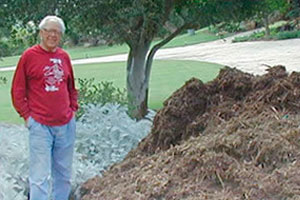
Mulch does a garden good!
Water less, reduce weeds, and complete the local yard waste recycling loop by using County Mulch! Get mulch for free from "Load Your Own" piles or find out more about low-cost loading and delivery options on this page.
Check out this great Mulch Video, produced by the City of Santa Barbara's Water Conservation Program, in collaboration with County staff.
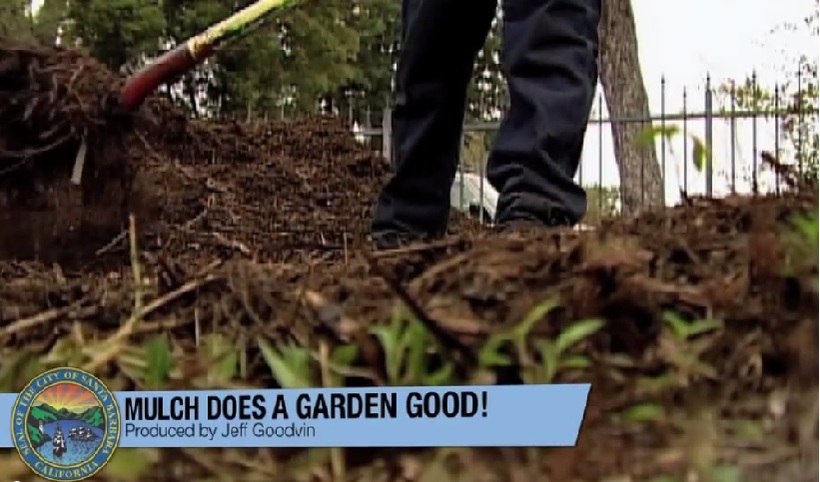
Find local mulch pick-up locations below, or check out this helpful interactive map.
Mulch is an excellent ground covering that limits weed growth, improves soil structure, reduces erosion, and retains water in soil. Mulch can be used over any bare or exposed soil, and is commonly applied around trees, on paths, as well as over slopes to help stop erosion. Read below for more great benefits.
Recent Changes to the Mulch Program
Due to the expansion of existing recycling operations and the introduction of new community recycling programs, Santa Barbara County will no longer be producing two mulch products. Previously, the County produced both regular and screened mulch. As of March 2022, the County will not be producing the screened mulch product. But don't worry! All of our mulch pick-ups, deliveries, and the load-your-own pile will still be available. Our regular mulch is a high quality product that has all of the benefits of screened mulch. Check out our FAQs below to learn more about our mulch.
How do I get Mulch?
Residents in Santa Barbara County can get mulch for their homes, gardens, and businesses in a few ways:
Free Mulch Piles
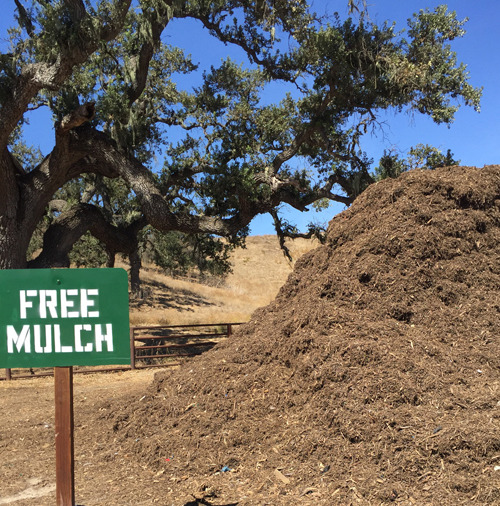
Free "load your own" mulch piles are available in Santa Barbara and Santa Ynez. Simply drive up with a pair of gloves and a garden fork and help yourself to as much mulch as you like. A tarp is recommended for open-bed trucks.
-
Santa Barbara:
- Pick-up is available at the South Coast Recycling and Transfer Station at 4430 Calle Real in Santa Barbara. The free pile is located right across the road from the facility and is accessible to residents 24 hours per day, 7 days per week.
-
Santa Ynez Valley:
- Pick-up is available at the Santa Ynez Valley Recycling and Transfer Station at 4004 Foxen Canyon Road in Los Olivos. The free pile, located by the front gate, is accessible to residents 24 hours per day, 7 days per week.
Loading of Mulch
Qualified trucks can be loaded with mulch in the South Coast and Santa Ynez Valley for a fee. A dual axle truck/trailer is required for mulch loads at the South Coast Recycling and Transfer Station. Please call ahead to confirm availability. For more information, please call the South Coast Recycling and Transfer Station at (805) 681-4345 or the Santa Ynez Valley Recycling and Transfer Station at (805) 686-5080.
Mulch Delivery
Getting mulch delivered by the County is easy. Follow this three step process for getting the mulch you need.
- Fill out the Mulch Purchase Agreement Form and send it in.
- Figure out how much mulch you need.
- Schedule a delivery.
- For mulch deliveries in Santa Ynez Valley, Santa Maria Valley, or Lompoc Valley, call Joey Costa at (805) 686-5084.
- For mulch deliveries on the South Coast, call Ray Angel at (805) 681-4981.
Mulch can usually be delivered within one to two weeks of a request. Please call ahead for current pricing.
Mulch Delivery Rebate for City of Santa Barbara and Goleta Water District Customers!
City of Santa Barbara
Because mulch reduces the need for watering by minimizing evaporation, residential and commercial City of Santa Barbara water customers can receive a rebate on up to two deliveries of mulch! This rebate program is limited to $45 per delivery or an annual maximum of $90 per fiscal year (July 1 - June 30). The mulch must be delivered to a site that is served by City water.
Please follow the delivery instructions above, pay the invoice up front, complete a rebate application, and remember to keep your invoice and proof of payment. The rebate application and more information can be found here on the City of Santa Barbara's website. Please note, this rebate is only available for mulch deliveries, not mulch loading. You can also see the City's mulch page here.
Goleta Water District
The Goleta Water District also offers a rebate on up to two deliveries of mulch (approximately 7-10 yards) per year for their customers. The program is limited to $85 per delivery or an annual maximum of $170 per fiscal year (July 1 through June 30).
Please follow the delivery instructions above, pay the invoice up front, complete a rebate application, and remember to keep your invoice and proof of payment. More information is available here on the Water District's website. If you have any additional questions, please call (805) 964-6761. Please note, this rebate is only available for mulch deliveries, not mulch loading.
Mulch Frequently asked Questions:
-
What are the benefits of using mulch?
- There are several benefits to using mulch for your landscaping and gardening needs:
- Reduces water usage by minimizing evaporation
- Suppresses weed growth
- Increases the soil's organic matter content
- Controls soil erosion
- Provides nutrients
- Improves soil structure and fertility over time
- There are several benefits to using mulch for your landscaping and gardening needs:
-
Where does the County's mulch come from?
- County mulch is produced from yard waste originating in our own gardens and landscapes. Yard waste (i.e. grass clippings, leaves, branches, and other yard trimmings) generated by residents and commercial businesses on the South Coast and Santa Ynez Valley is collected curbside in green waste carts. This material is hauled to a central location, ground into mulch, and offered back to the community at either the South Coast Recycling and Transfer Station or Santa Ynez Valley Recycling and Transfer Station. Some yard waste is also self-hauled to the transfer stations by landscapers, tree trimmers, and homeowners.
- Green carts available to residents and commercial businesses in the Santa Maria and Lompoc Valley areas can accept all types of organic waste, including food waste and wet or food-soiled paper along with yard waste. Due to the presence of food waste in this region's green cart program, this material is composted instead of ground into mulch.
-
Who uses the County's mulch?
- The mulch produced by the County is distributed to a variety of end users. The largest end use is in agricultural applications, such as avocado and citrus orchards, commercial nurseries, and vineyards. The mulch is also used by a diverse group of organizations, including the following:
- Churches
- Schools
- Public parks such as the Alice Keck Park Memorial Gardens
- Private estates such as Lotus Land
- Nonprofit organizations such as the Urban Creeks Council and Goleta Beautiful for habitat restoration and beautification projects
- A large number of private residences
- The mulch produced by the County is distributed to a variety of end users. The largest end use is in agricultural applications, such as avocado and citrus orchards, commercial nurseries, and vineyards. The mulch is also used by a diverse group of organizations, including the following:
-
How clean is the County's mulch?
- A Quality Assurance/Control Program ensures the production of a clean product that may be safely applied to ornamental plants, fruit trees, and vegetable gardens. Through their franchise agreements with the County, private solid waste hauling companies are responsible for ensuring that residentially collected green waste has a low level of contaminants. Painted and treated plywood and creosoted woods are removed prior to grinding, and electromagnets recover ferrous metals such as nails.
- Processed mulch cures for two to three days to generate enough heat to destroy weed seeds. A small amount of inert and film plastics may remain. To date, the County has not received any complaints or anecdotal evidence that use of its mulch has resulted in any damage to plants or caused human health problems.
-
How much mulch will I need?
- The amount of mulch that you'll need depends upon the size of the area you wish to apply the mulch to and the depth of application. In addition, mulch will break down over time and will need to be reapplied periodically in order to continue the benefits of its use. There are approximately 3.5 cubic yards per ton of County mulch. This ratio will vary slightly depending on the moisture content. The following general application rates may assist you in determining what your needs will be:
-
For home applications:
- 3 inch application: 1 cubic yard will cover approximately 109 square feet
- 4 inch application: 1 cubic yard will cover approximately 81 square feet
- 6 inch application: 1 cubic yard will cover approximately 54 square feet
-
For orchard applications:
- 4 inch application: 538 cubic yards or 154 tons will cover 1 acre
- 6 inch application: 807 cubic yards or 231 tons will cover 1 acre
- 8 inch application: 1,076 cubic yards or 307 tons will cover 1 acre
If you have any questions regarding the County's mulch program, please call Joey Costa at (805) 686-5084 or send him an e-mail message.
Where to go
-
Santa Barbara Area (3)
- *South Coast Recycling and Transfer Station — 4430 Calle Real
- Agri-Chip — 132 Garden St
- MarBorg Industries — 119 North Quarantina Street
-
Goleta & UCSB Area (1)
- *South Coast Recycling & Transfer Station — 4430 Calle Real
-
Santa Ynez Valley (1)
- *Santa Ynez Valley Recycling and Transfer Station — 4004 Foxen Canyon Road
Related Materials
- Yard Waste Reduction
- Agricultural Waste Recycling
- Private: Outreach Materials
- Recycling Resource Guide
- Agricultural Plastic Recycling
- Green Cart Recycling
- Untreated Wood & Pallets Recycling
- Home Composting
- Manure Recycling Program
- Pesticides, Herbicides and Fertilizers
- Composting Workshops
- Christmas Tree Recycling
- ReSource Center Experience
- ReSource Center and Tajiguas Landfill Tours
- Waste Reduction in Action!
Related Articles
-
America Recycles Day November 15th
November 08, 2019 by Leslie Robinson - Recycle -
Compost Your Pumpkins (and other organics)!
November 01, 2019 by Sam Dickinson - Organics -
County Programs Available to Reduce Organic Waste
April 09, 2018 by Sam Dickinson - Organics -
RRWM’s Annual Waste Management Report Now Available
October 05, 2017 by Alan Nakashima - Recycle -
County Awarded for Excellence in Solid Waste Management
August 15, 2017 by Tom Chiarodit - Recycle -
Mini Composting Workshops this Thursday at SBCC’s Earth Day Event
April 17, 2017 by Sam Dickinson - Organics -
Learn the Composting ABC’s
April 15, 2014 by Sam Dickinson - Organics -
County Mulch Available for Drought Relief
February 13, 2014 by Tom Chiarodit - Organics -
Redefining Waste Recovery
June 03, 2019 by Carlyle Johnston -
New Food Forward Booklet Available!
August 21, 2019 by Sam Dickinson -
Christmas Tree Recycling
December 26, 2023 by Kaitlyn Haberlin - Organics -
Treated Wood Waste No Longer Accepted at County Facilities
December 27, 2020 by Kaitlyn Haberlin -
New Eucalyptus and Oleander Separation Requirements
January 03, 2021 by Kaitlyn Haberlin -
2019/2020 Resource Recovery Waste Management Annual Report Now Available!
January 11, 2021 by Tori Kampmann -
“Less Is More” Guide Hot Off the Press
January 18, 2023 by Kaitlyn Haberlin - Recycle, Reduce & Reuse -
2023/2024 Resource Recovery Waste Management Annual Report
February 12, 2025 by Owen Walsh -
Screen Your Green (bin)!
September 01, 2024 by Kaitlyn Haberlin - Organics -
Check Out RRWM’s New Waste Reduction and Recycling Calendar for 2025!
January 03, 2025 by Kaitlyn Haberlin - Reduce & Reuse